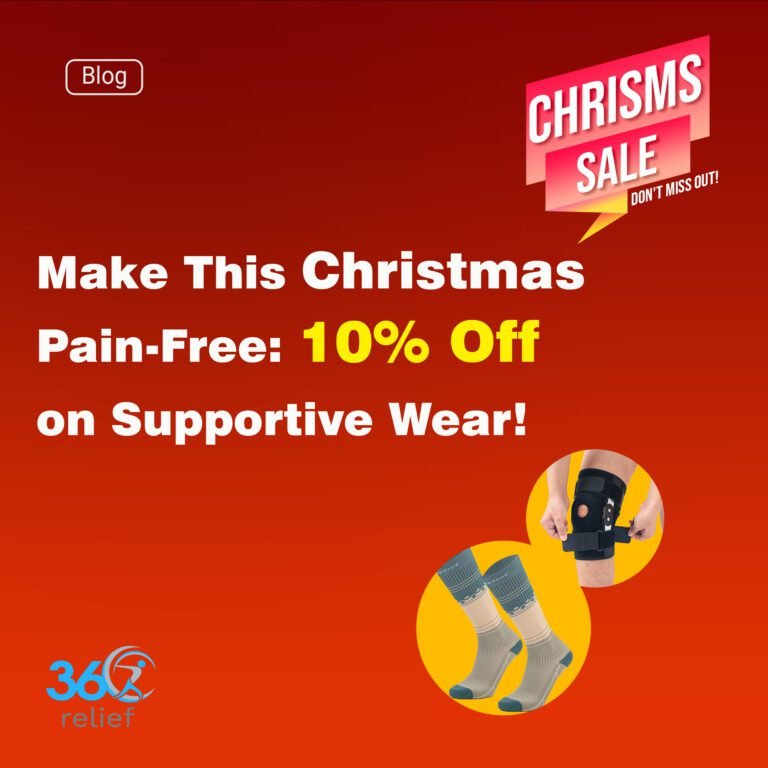
Make This Christmas Pain-Free: 10% Off on Supportive Wear!
Holidays are coming, which means that let’s welcome them with joy, laughter, and, of course, some comfort! At 360 Relief,
Repetitive Strain Injury is becoming more common as we spend more time in front of our computers, phones, and tablets. People are having to work for longer hours during this recessionary time, with less flexibility in their workloads. The good news is that if you understand the causes of Repetitive strain injuries, you may take steps to alleviate and even prevent the problem.

Repetitive Strain Injury (RSI), also known as Overuse syndrome, it’s the slow accumulation of tissue damage caused by repetitive movements and/or overuse. It is the pain in Muscles, Nerves and tendons. RSI can affect any moveable part of the body, but it is most commonly found in the upper limbs, particularly in neck, shoulders, forearms, and hands. It’s also known as work-related upper limb disorder, or non-specific upper limb pain.
General Relationship between the different Factors Involved in bringing on a Repetitive Strain Injury as represented below:
I=N*F/A*R
I= Total damage to the Tissue
N= Number of repetitions
F= Force used to perform each repetition
A= Movement
R= the rest time where the tissue is not under tension or in an awkward posture

Regardless of the diagnosis, if pain and discomfort are neglected, they can begin to affect your work productivity as well as your ability to complete daily routine tasks. To help alleviate your discomfort, you can start making some changes on your own.
Do any of your activities need you to hold a static position or perform a lot of repetitions? These have a high risk of causing a repetitive strain injury. Have you increased the number of repetitions or the time you spend on activities like sitting, typing, texting, and running?

Brace/supports can assist to alleviate pain and prevent it from getting worse. Adjustable Wrist & Hand supports are often recommended for people with carpal tunnel problems. A wrist brace is very effective at keeping your wrist in a neutral position.
Knowing where the problems lie doesn’t mean you can relax. Make a plan, quantify what you’re doing, and make sure you’re doing it well. If you’re looking for the right braces/Supports then click here.
Holidays are coming, which means that let’s welcome them with joy, laughter, and, of course, some comfort! At 360 Relief,

Happy Cyber Monday to everyone; it is a perfect occasion for 360 Relief to offer a special discount of 10%

This Black Friday, take advantage of exclusive 10% savings on some of 360 Relief’s best-selling compression socks and support braces!

Everyday life includes walking up stairs, but knee discomfort can make this basic activity difficult. Walking up or down stairs

Cooking is a beloved activity for many, but for those struggling with knee pain, standing in the kitchen can quickly

We’ve all been there. On a ride in a car, for instance, to the country home for a weekend break

Gardening is enjoyable for many people and those who like tending to their lawns and plants usually find it therapeutic

Do you have a painful knee problem that takes you to physiotherapy…for an injury that hampers your daily living…your workout

Training can be very much associated with some pains and injuries that may be experienced by the trainers. As there

Office workers often spend hours seated at their desks, focusing on tasks while unknowingly putting their health at risk. The

Winter often brings more than just a change in weather; for many, it also means dealing with unexpected swelling in

Compression socks have become a critical tool for athletes across all sports. Whether you’re a marathon runner, cyclist, or weightlifter,

October marks the beginning of National Cholesterol Month in the UK, a time dedicated to raising awareness about cholesterol and

Overall, there is nothing to match the experience of watching musicians perform live in an outdoor concert in Glastonbury. However,

Today charity runs have gained popularity as a way of raising cash for a cause in the United Kingdom. From